


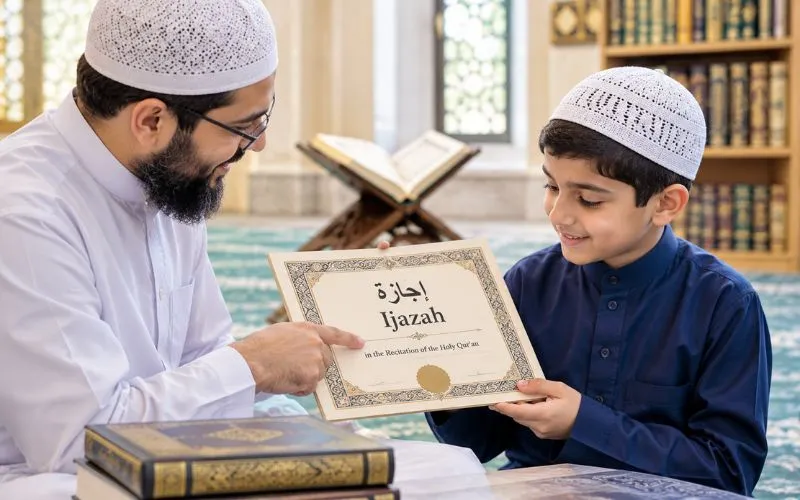
An Ijazah is a teacher’s permission to teach the Quran. A student earns it by reciting to a teacher who already holds one, getting corrected, and being judged ready. It also records a chain: who taught you, who taught that teacher, and so on, back to the Prophet ﷺ.
Every tutor at MY QURAN TUTOR holds one. People nod when they hear the word “Ijazah” and then rarely ask what it proves. This post covers what it is, how a person gets one, what it does not prove, and how you can check a tutor’s claim yourself.
The Short Version
- What it is: a teacher’s permission to pass the Quran on, given after the student recites and is corrected.
- What it proves: the tutor learned the Quran by reciting to a teacher, and that teacher trusted them to teach it.
- What it does not prove: that the tutor can teach a child, speak good English or turn up on time.
- How to check: ask who gave it, ask which reading it is in, and ask to hear the tutor recite.
Where the Word Comes From
Ijazah is an Arabic word meaning permission or licence. In Islamic learning it means permission to pass on a text or a subject, and only someone who already holds that permission can give it.
The Quran has always been learned from a teacher’s mouth to a student’s ear. The scholarly term is talaqqi, direct learning from a teacher. It goes back to the Prophet ﷺ himself. Ibn Abbas reported that Jibril reviewed the Quran with the Prophet ﷺ every night of Ramadan. Reading a book was never the method. You recited, someone who knew it listened, and they corrected you.
That is why an Ijazah is personal. A university degree comes from an institution. An Ijazah comes from one named teacher who sat with you.
How Someone Earns an Ijazah
The details differ between teachers and between types of Ijazah, but the pattern is steady.
- The student learns to read properly, with correct makharij (where each letter comes from) and the basic Tajweed rules.
- The student then recites the Quran to a teacher who holds an Ijazah. In many cases this is done from memory, start to finish.
- The teacher listens and corrects. A word, a stretch, a stop, a letter that sits slightly in the wrong place.
- When the teacher is satisfied, they grant the Ijazah. In a written one, they name themselves, their teacher, and the line behind them.
How long it takes depends on the student and the teacher. For some it is months. For others it is years. I don’t know of any honest way to promise a timeline, so I am wary of anyone who does.
The Chain Behind the Paper
The chain is called a sanad. It is the list of teachers who passed the recitation from the Prophet ﷺ to the person in front of you. One published example of an Ijazah in the Hafs reading lists a chain of around 30 names.
Scholars treated this seriously. A reading is only accepted if it matches the written text compiled in the time of Uthman, fits Arabic grammar, and has an authentic chain. A reading that fails these tests is set aside.
So when a tutor says they hold an Ijazah, the question behind it is simple: who did you recite to, and who did they recite to?
Which Reading Is the Ijazah In?
This is the question almost nobody asks, and it is a good one.
The Quran is recited in ten recognised readings, called qira’at. Ibn Mujahid (died 324 AH) fixed the well-known list of seven, and Ibn al-Jazari (died 833 AH) added three. Each reading has two narrators, so there are twenty narrations in all.
You do not need to learn all twenty. You only need to know which one your tutor holds and which one you are learning:
- Hafs from Asim: the narration most widely used across the Muslim world.
- Warsh from Nafi: common in parts of North Africa.
- Al-Duri from Abu Amr: used in places such as Sudan and Somalia.
Whichever reading you are learning, ask your tutor which one their Ijazah is in. A tutor who understands their own Ijazah can tell you in one sentence.
Ijazah, Hafiz, Qari and a Tajweed Certificate: Four Different Things
These terms get mixed up all the time, even by people who run academies.
| Term | What it means |
|---|---|
| Hafiz | Someone who has memorised the whole Quran |
| Qari | Someone trained to recite the Quran well |
| Tajweed certificate | Usually shows that a person completed a course on the rules of recitation |
| Ijazah | Permission to teach, from a teacher, with a chain behind it |
A person can be a Hafiz without an Ijazah. They memorised it, and nobody has yet formally listened to them and authorised them to teach. That is why we ask for both.
What an Ijazah Does Not Tell You
This is where I want to be straight with parents.
An Ijazah tells you a tutor can recite, and that someone qualified trusted them with the Quran. It tells you nothing about whether they can hold the attention of a six-year-old for thirty minutes through a screen.
Teaching children takes a different set of skills. Patience. Knowing when to stop and when to repeat. Making a small child want to come back tomorrow. That is why every new tutor goes through 15 to 20 days of training after they join, and teaches a mock class to one of our admins before meeting a student. You can read the full process in How We Vet Our Quran Tutors.
How to Check a Tutor’s Ijazah Yourself
You do not need to be a scholar to do this. You need five questions.
- Who gave you your Ijazah? A real answer is a name. “An institute” is not a name.
- Which reading is it in? Hafs from Asim is the common answer. Any answer is fine as long as it is clear.
- Who was your teacher’s teacher? A tutor who truly received the chain knows at least the next link.
- Can I hear you recite for a minute or two? Two minutes tells you more than a certificate image.
- Do you hold an Ijazah in recitation, in memorisation, or both? This helps you understand what you are buying.
A good tutor will answer all five without fuss. Hesitation is not a crime, but if the answers stay vague after you ask politely, move on.
Do Women Hold Ijazahs Too?
Yes. Access to an Ijazah has not been limited by gender. Historical records name women among the scholars who earned and gave Ijazahs, and the hadith scholar Zaynab bint al-Kamal is one example. Our female tutors hold the same credentials as our male tutors, and you can read more on our Female Quran Teacher page.
Why We Make It a Rule
There is no law that says only an Ijazah holder may teach the Quran online. Anyone can start an academy tomorrow. So this is a standard we choose, not a requirement we are forced to follow.
We choose it because the Quran is passed on as it was received. A child’s first teacher sets how they hear every letter for years to come. I would rather that teacher had sat with someone who sat with someone else, all the way back, than learned it from a video.
That is why every tutor with us holds an Ijazah, is a Hafiz and a Qari, and knows Tajweed. It is also why we do not stop there.
FAQ
What is an Ijazah in Quran?
It is a teacher’s permission to teach the Quran, given after the student recites and is corrected. It usually includes a chain of teachers going back to the Prophet ﷺ.
What does Ijazah mean in Arabic?
It means permission or licence.
Is an Ijazah the same as being a Hafiz?
No. A Hafiz has memorised the whole Quran. An Ijazah is permission to teach, given by a teacher, with a chain behind it. A person can be a Hafiz without an Ijazah.
How long does it take to get an Ijazah?
It depends on the student and the teacher. For some it takes months. For others it takes years.
What is a sanad?
A sanad is the chain of teachers through which a recitation was passed on, from the Prophet ﷺ to the person who holds the Ijazah.
What are the qira’at?
They are the ten recognised readings of the Quran, each with two narrators. Hafs from Asim is the most widely used.
Does a tutor need an Ijazah to teach Quran online?
No law requires it. It is the traditional standard, and it is the one we hold. Every tutor at MY QURAN TUTOR has one.
How can I check whether a tutor really has an Ijazah?
Ask who gave it, which reading it is in, and who taught their teacher. Then ask to hear them recite for a minute or two.
Do your female tutors have an Ijazah?
Yes. Female tutors hold the same credentials as male tutors.
See How an Ijazah-Holding Tutor Teaches
The best way to judge a tutor is to sit in on a class. Book a free trial class and ask your tutor the five questions above. They will not mind.