


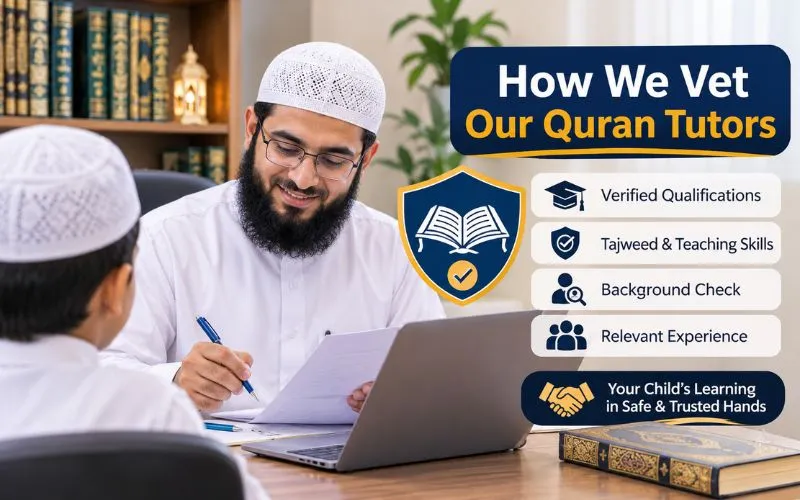
Every tutor at MY QURAN TUTOR is a Hafiz and a Qari, holds an Ijazah, knows Tajweed, speaks good English and turns up on time. After that, they spend 15 to 20 days in training and teach a mock class to one of our admins. All of this happens before a student is involved.
That is the short answer. The rest of this page explains why we ask for each thing, because “qualified tutor” is a phrase every Quran academy uses, and on its own it tells you very little.
The Short Version
Here is every step a tutor goes through with us, in order.
- Hafiz and Qari. They have memorised the whole Quran and are trained to recite it.
- Tajweed. They know the rules of recitation and apply them.
- Ijazah. They hold a certificate of permission to teach the Quran.
- Good English. They can explain things clearly to students in the UK, USA, Canada, Australia and Europe.
- Regular and punctual. They show up, and they show up on time.
- Background check. Every tutor goes through a formal background check.
- 15 to 20 days of training. They learn how to teach, which is a different skill from reciting.
- A mock class. One of our admins plays the student, and the new tutor teaches.
Male and female tutors meet the same requirements.
Why Every Tutor Is a Hafiz and a Qari
A Hafiz has memorised the entire Quran. A Qari is someone trained to recite it properly. We ask for both.
The reason is simple. A teacher can only take a student as far as their own recitation goes. A child starting Noorani Qaida needs to hear the right sound for every letter from the very first class. If they pick up the wrong sound early, it takes real effort to fix later. We would rather the first teacher they hear is someone who has the sounds right.
Tajweed and Ijazah
Tajweed is the set of rules for pronouncing the Quran correctly. Plenty of people know about Tajweed. Fewer apply it every time they open their mouth, and that second group is who we want in front of a student.
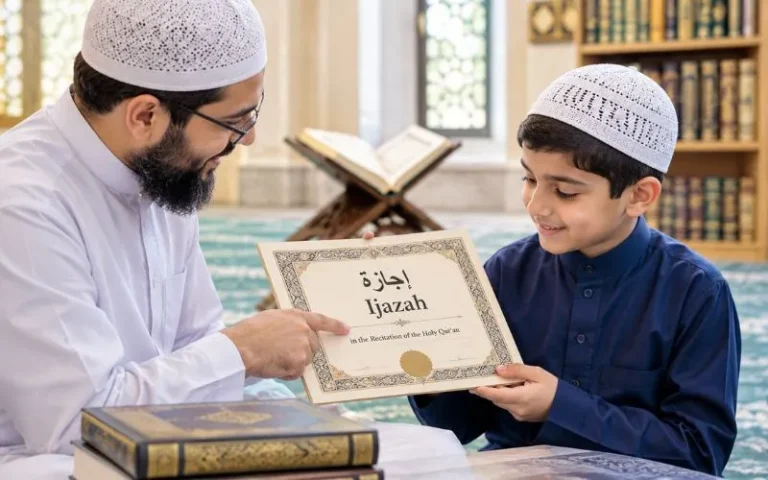
An Ijazah is a teacher’s permission to pass the Quran on to others, and it traces back through a line of teachers. In plain terms, it means a teacher listened to the tutor recite and decided they were ready to teach. Every tutor we work with holds one.
Why Good English Matters
Our students live in the UK, the USA, Canada, Australia, Europe and many other places. A lot of them are children, and children ask questions in English.
If a tutor cannot follow a seven-year-old’s question, they cannot answer it. So clear spoken English is a requirement for every tutor, male or female. Without it, even a great reciter would struggle to help a child who is stuck.
Regular and Punctual
Picture a child with a 4:30 class and dinner at 5:15. A tutor who knows everything but turns up ten minutes late is a bad deal for that family.
Children settle into routines quickly, and parents plan their evenings around class time. We treat being regular and on time as part of the job from day one.
15 to 20 Days of Training, Even After All That
This is the part that surprises people.
A tutor can have every qualification above and still not be ready to teach a six-year-old through a screen. Reciting well and teaching well are two different skills. So every new tutor goes through 15 to 20 days of training. It covers:
- How to teach one student at a time
- How to deal with different age groups, because a 5-year-old, a 14-year-old and a 45-year-old need different handling
- How to keep young children interested during a class
That last one matters more than it sounds. A small child’s attention is short, and a tutor who cannot hold it will lose the lesson however much they know.
The Final Test: Our Admin Becomes the Student
When training ends, we test the tutor ourselves. One of our admins sits in as the student, and the new tutor teaches them the way they would teach a real student.
By the end, the admin has a good idea of how well that tutor teaches, and how well they recite is only part of it. We find that out before any student is involved.
What This Means for Your Family
- Your child’s first class is with someone who has been trained to teach children, and who has already taught a practice class.
- If you prefer a female tutor, she goes through the same steps. See our Female Quran Teacher page.
- You can check all of this yourself. Book a free trial class and see how your tutor teaches.
Questions to Ask Any Quran Tutor
These work whichever academy you choose.
- Are you a Hafiz or a Qari?
- Do you hold an Ijazah, and who is it from?
- Have you been trained to teach children online?
- Can you explain things to my child in English?
- What happens if you can’t make a class?
A good tutor answers these easily. If the answers are vague, that tells you something too.
FAQ
Are all MY QURAN TUTOR teachers Hafiz?
Yes. Every tutor is a Hafiz and a Qari.
Do your tutors have an Ijazah?
Yes. Every tutor holds an Ijazah.
Do your tutors know Tajweed?
Yes. Knowing Tajweed is a requirement for every tutor.
Do you have female tutors, and are they held to the same standard?
Yes. Male and female tutors meet the same requirements.
Do your tutors speak English?
Yes. Good English is a requirement, so students and parents in English-speaking countries can ask questions and get clear answers.
Are your tutors background-checked?
Yes. Every tutor goes through a formal background check.
How long is the training?
15 to 20 days. It covers how to teach one student, how to handle different age groups and how to keep young children engaged.
How do you test a new tutor?
After training, one of our admins plays the student and the new tutor teaches them. The admin sees how well the tutor teaches before any real student is involved.
Can I try a tutor before I commit?
Yes. You can book a free trial class.
Meet Your Tutor in a Free Trial Class
Reading about our process is one thing. Watching a trained tutor teach your child is better. Book a free trial class and see for yourself.